
Ever meet someone in passing who helps bring a little perspective into your life? Sometimes it takes a modest overachiever to make you realise that you should be proud of your own achievements.
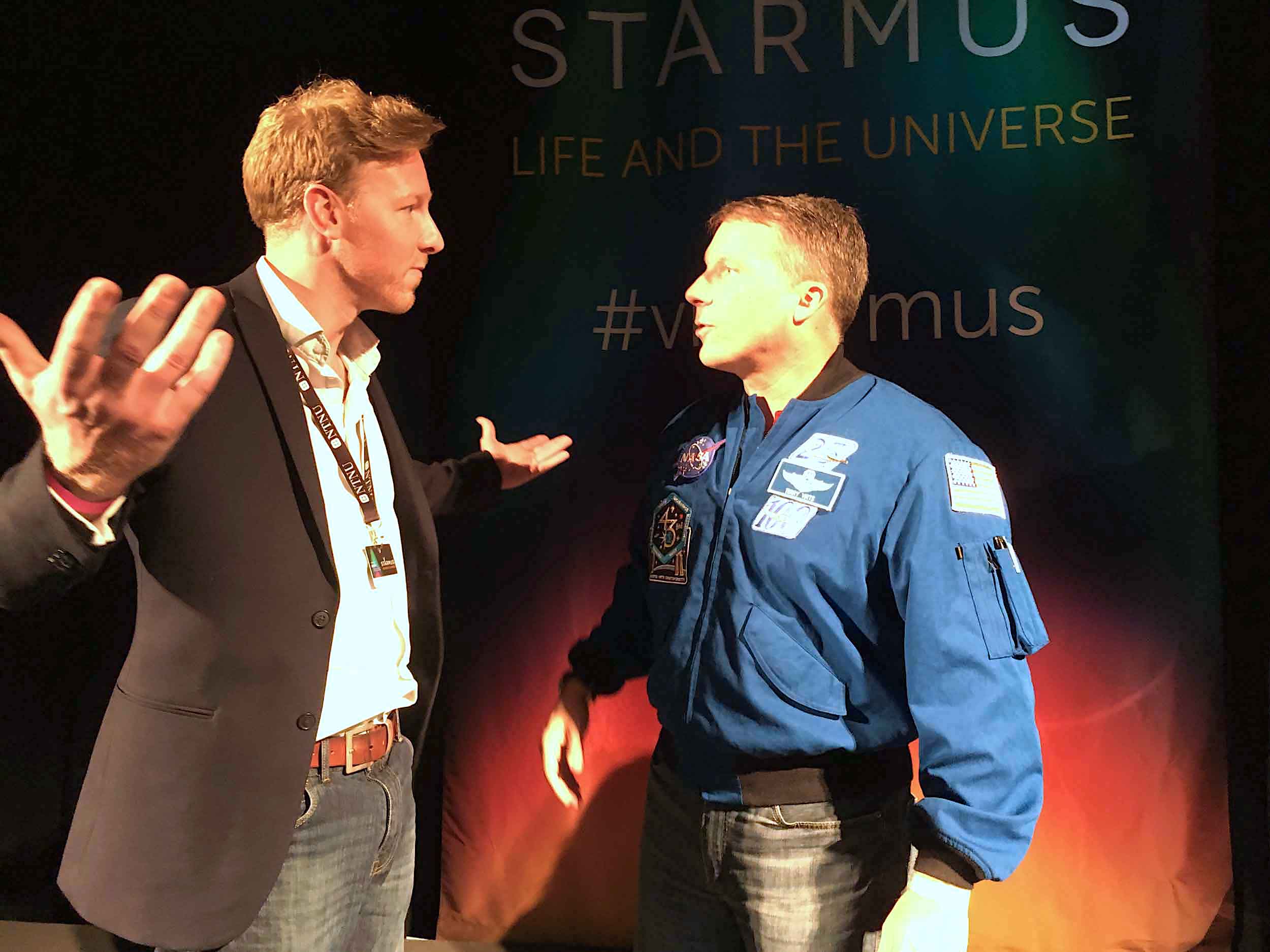
The picture above is of me interviewing US astronaut and celestial coiffeur Terry Virts some years ago at an event in Norway (Starmus), and while it may look like we’re about to throw down, I remember the moment very fondly indeed.
Terry had just told me why he considered himself one of the least qualified members of the team, despite having become a fighter pilot, clocked up 5,300 flight hours in 40 different aircraft, earned a degree and various qualifications from institutions including Harvard and been a vital liaison between astronauts and mission control on earth. I was incredulous.
But he was probably right. A native of Maryland in the US, Terry grew up in Columbia and graduated from high school in 1985, going on to earn a maths degree (minoring in French) from the US Air Force Academy in 1989 and a masters in aeronautics from the Embry–Riddle Aeronautical University in 1997. Academically inauspicious in comparison with his contemporaries.
But Terry had the stars in his eyes from the beginning, and his route to the ISS began when he attended the École de l’Air in 1988 on an exchange programme. Years later, sitting aboard his first space flight (Endeavour, 2010), being propelled through the exosphere towards the ISS at 17,500 miles an hour, I believe he would have had complete trust in the team at mission control responsible for his venture into the vast emptiness of space.
This is because he had been one of them.
Six years before our interview, Terry had served as a crew support astronaut for Expedition 9, assisting the mission’s crew members and even assuming the role of capsule communicator (CAPCOM), a vital link between ground control and the team of astronauts in space. The role was previously occupied on Apollo 11 by Charles ‘Charlie’ Duke, the tenth man to walk on the moon, and more on him later.
Least qualified or not, Terry definitely had the right stuff.
Standing on the shoulders of giants
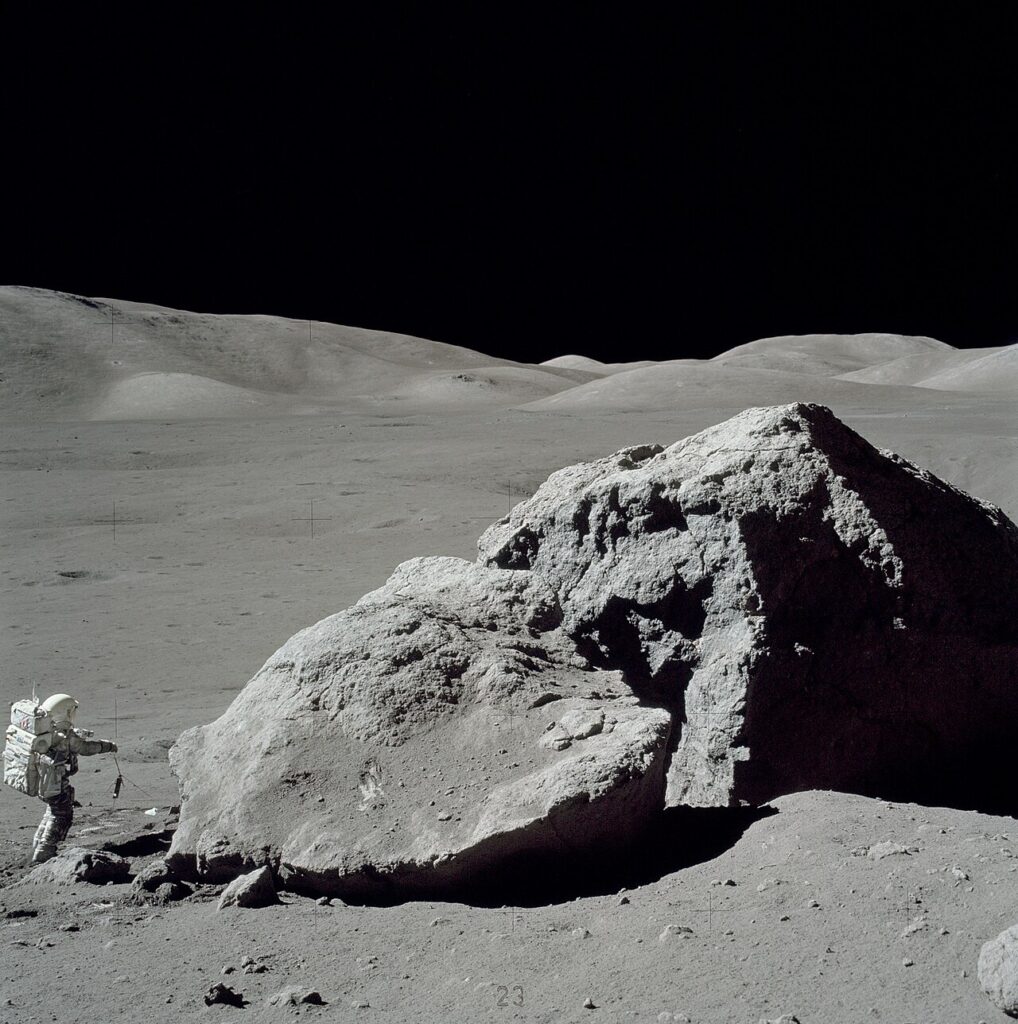
The next day, while heading to the cafeteria in the conference hotel at which the guests and speakers were staying, I shared the elevator with Harrison ‘Jack’ Schmitt, the most recent living person to have walked on the moon, and his wife Teresa.
Schmitt was something of a Norwegian local, having spent a year studying geology at Oslo University on a Fulbright Scholarship. In fact, this incredible man became one of NASA’s first group of scientist-astronauts in June 1965 after receiving his PhD in geology from Harvard University in 1964, based on his studies in Norway. Further from home, he was the only scientist-astronaut to travel beyond low Earth orbit, participate in the longest manned lunar landing flight (301+ hours) and walk on the moon.
But to me, a blinking simian with knowledge only of the fact that I couldn’t even connect my laptop to a printer that morning, he was an impossibility. Having listened to his exploits the day before, I just stared at him and his lovely wife as if I had stepped into the lift with a pair of pangolins. Eventually he extended his hand and introduced himself. I replied in kind and said it had been a privilege to hear him speak. He said thank you and introduced Teresa, then asked me what I was doing there (a question I had asked myself the second I entered the lift), and if I had any recommendations for the breakfast bar.
Schmitt is still alive, with 90 years chock full of stories that he continues to share with normies like me around the world. Many of his tales will be recounted by another luminary of NASA’s manned space missions, Charlie Duke, CAPCOM for Apollo 11; the first crewed landing on the moon.
In fact, it was an account of Duke’s experience on Apollo 16 in 1972 that stayed with me the most. During one of his three excursions to the moon’s surface (amounting to more than 71 HOURS) Duke and John Young were conducting scientific experiments and collecting almost 100 kilograms of rock and soil samples, when their lunar roving vehicle (LRV) came to an unscheduled halt on some of the roughest surface they’d yet encountered. Or, put another way, his car broke down on the moon.
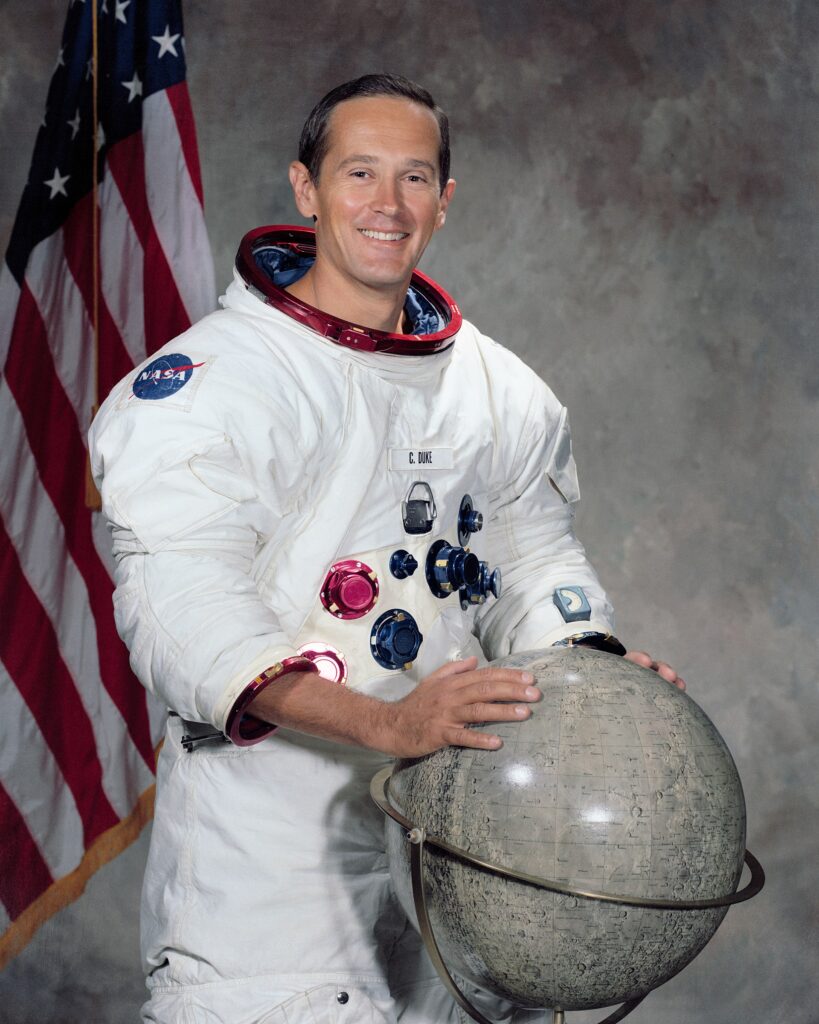
Whether unfortunate, careless or over-ambitious, Duke – the mission’s Lunar Roving Vehicle specialist – now found himself stranded almost three miles from the Lunar Landing Module (LLM), the lifeline that returns the crew from the moon’s inhospitable surface to the barely survivable shuttle above. He knew, as he stared at the pale blue dot in the distance, that if he couldn’t fix it, the LLM would lift off without him and he would die.
This was completely beyond my comprehension. Half a century later, a man who had given up all hope of connecting his modern laptop to a printer in a cushy hotel business suite, was listening to another man’s account of repairing 1970s potato technology in a place unfit for life of any kind, in the freezing shadow of a crater 240,000 miles from Earth.
The right stuff indeed, but this year even Duke confessed to imposter syndrome in his appearance on the Servant Leadership Podcast, urging listeners to beat it by admitting what you do not know and positioning yourself as a mentor to others in order to help them to overcome self-doubt.
Same shot, different day
The people who sit aboard the Orion spacecraft at this very moment, hurtling through space towards the rock on which you are reading this, are cut of the same cloth, and I bet they’re just as afraid of accepting their success as their predecessors.
Terry Virts may call himself the least qualified of his colleagues, but his endeavour (pun intended) is what made Artemis 2 possible. And fifty years later, as the astronauts stow their gear for re-entry, the risk to life is just as present.
“Let’s not beat around the bush,” Artemis 2 lead flight director Jeff Radigan said in yesterday’s briefing (Thursday, April 2), “we have to hit that angle correctly, otherwise we’re not going to have a successful entry.“
The reason for this is that Orion’s return trajectory plan for Artemis 2 was altered when the heat shield on its predecessor, Artemis 1, experienced heat degradation and material loss during re-entry. Tomorrow, rather than entering the atmosphere head-on, Orion will perform what’s known as a ‘lofted’ reentry, dipping down into the atmosphere briefly, before delving back down for its final descent.
NASA describes this, terrifyingly, as similar to a stone skipping once across a pond before sinking beneath the water. This will hopefully (well, via calculation) reduce heat stress on Orion’s heatshield, and decelerate the spacecraft incrementally and reduce the heat damage by redistributing the energy. But the risk remains and the team is on high alert.
“To every engineer, every technician that’s touched this machine; tomorrow belongs to you,” added NASA Associate Administrator Amit Kshatriya. “The crew has done their part. Now we have to do ours.”
It takes an incredible degree of trust to place your fate in the hands of another, or team of others. Whether it’s your friends, your family, your colleagues or a round-the-clock team of geniuses trying to navigate you safely back to earth through the freezing vacuum of space, we are propelled by those we are placed amongst, or with whom we surround ourselves.
Our individual shortcomings, unsubstantiated, self-imposed or otherwise, are mitigated by the groups who support us. And as Terry must know by now, everyone who ever doubted themselves is revered by someone else as an overachiever in some capacity.
I wish the team aboard Artemis 2 all the luck in the world, and beyond.
Interesting fact, Terry Virts developed a flare for hairdressing on the ISS (a complicated process using specialised vacuum devices attached to clippers to collect filter-clogging trimmings) and became the resident hairdresser aboard the ISS. In doing so he also emerged as the fastest hairdresser yet produced by our species, given his salon was circling the earth every 90 minutes.
Leave a Reply