
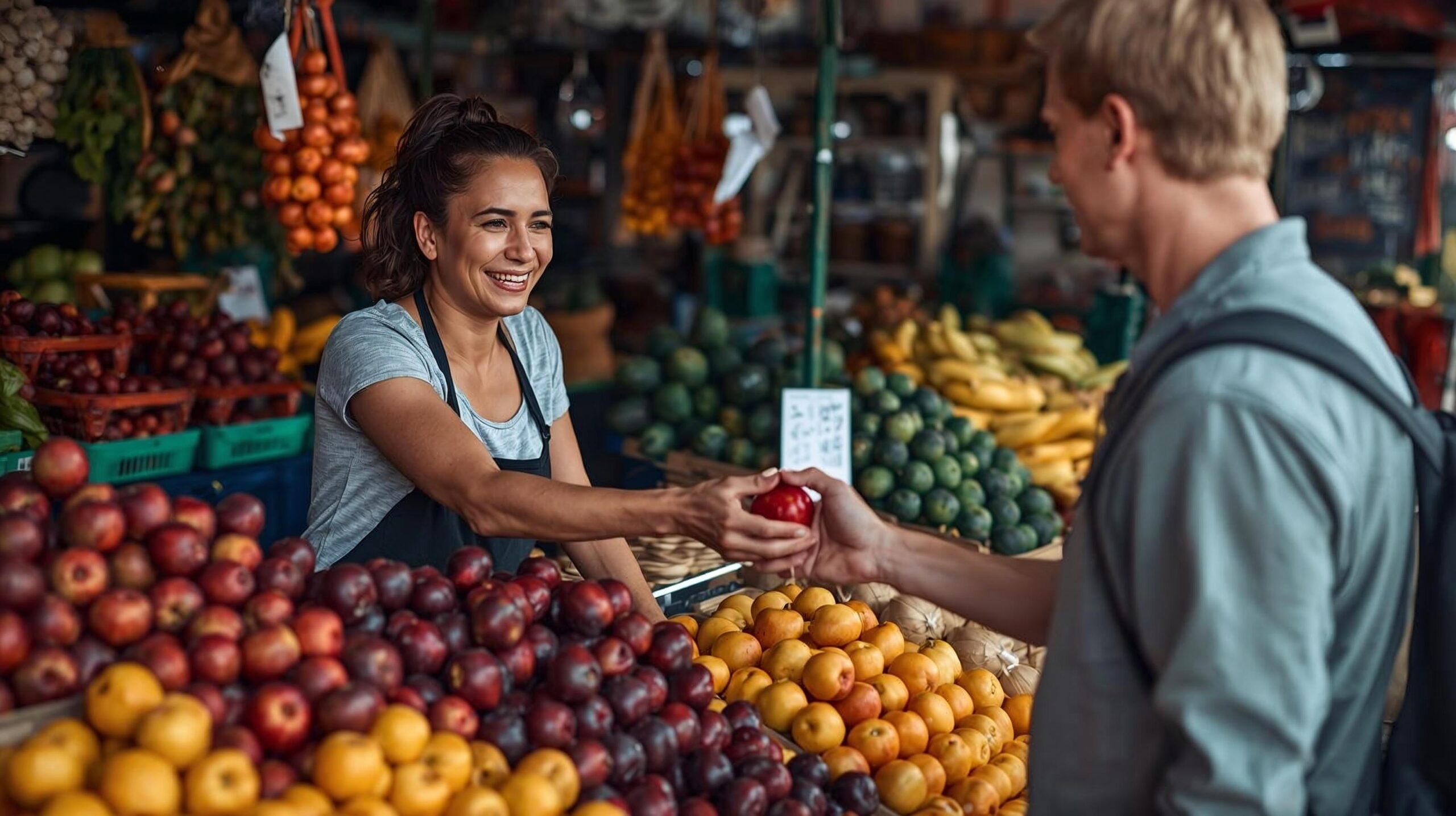
I live in a market town. On Tuesday I stop by the market after dropping the kids off and buy our fruit and vegetables for the week. I don’t do this in the name of community, or to sustain the market’s continued existence, I do it for entirely selfish reasons.
The reason I shop at the market is that the greengrocer knows what I like. If a particular fruit I buy from her stall is sweeter than usual, or she has an interesting alternative, she will tell me. When my kids tire of whatever green stuff I’m trying to sneak onto their plate every evening, she’ll save me an argument by suggesting something else she thinks they’ll like. We even share recipe ideas.
Hers is not the only fruit and veg stall in the market, but she is the only one who knows me.
This is a level of service that is very difficult to emulate in an exhibition. My greengrocer wouldn’t be able to advise me on the produce I might like if I was just one of 30,000 people who visited her stall on a Tuesday.
Perceived service, not scale
But, I hear some of you say, you absolutely can achieve this degree of service with the sophisticated personalisation that AI tools now bestow upon our customer pipeline.

Cue a few boring paragraphs explaining how my greengrocer could essentially use this technology to become Professor Xavier from the X-Men, able to keep tabs on all 30,000 customers using his all-knowing Cerebro machine.
But you know all that, and in any case it misses the point. My relationship is with the greengrocer; the event director in this analogy. I don’t know the team that manages the market square (the organiser), I certainly don’t want it made clear that I’ve been placed in their corporate sales funnel, and I probably don’t want their emails.
This isn’t about scale; it’s about perceived service.
In its recent article Designing For Trust: Four Shifts Reshaping B2B Marketing In 2026 1, Forbes journalist Jenny Herbison writes:
“AI and chatbots will make discovery faster, but they should hand over the reins to a human when the stakes rise. No one wants to be funneled. Put customers in control, remove friction, and show exactly which tasks shrink, which risks reduce and which handoffs disappear “
Herbison goes on to make the point that audiences are done with vague AI talk, and that a bot that cannot solve a problem “erodes trust faster than silence”. Knowing the path to your resolution, she claims, requires a named contact and service standards to which you are dedicated.
Returning to my relationship with my greengrocer, she is crucial because she will provide me with a qualified response at the first time of asking, and she will base that response on my demeanour and other clues that will not come across on a form.
I may ask her for something that’s full of iron for the kids during a growth-spurt, but she may suggest something that complements red meat or pulses instead. The conversation gives me the result I wanted for the kids, but not in the way I predicted.
To do this, we have to invest in employees with responsibility for first-line response. They require training and briefing on the needs of those who will approach them, and there needs to be enough of them to do the job. My greengrocer in team format.
We need to keep “a human in the loop for high-judgment work and one‑to‑one communication, and to protect a distinctive voice so you do not sound like everyone else,” as Herbison puts it.
“Coming together is a beginning; keeping together is progress; working together is success” – Henry Ford
Instead of AI, this could also be where I talk about the Community. Instead of listening to my greengrocer, I could listen to the crowd gathered around her stand and work out which ones I align myself with, and buy what they suggest I buy instead.
But this also misses the point. I might return to the stall to hear these recommendations, but the greengrocer has no control over them. If I know what’s good, I might go direct to the supplier. What’s to stop this community setting up somewhere else and calling the suppliers directly like we’re placing some giant takeaway order.
There are simply too many ways (platforms) in which this crowd can exchange information beyond his control, and too many ways in which they can access the supplier directly.

Look at the telecoms industry; four times as many people (>20%) now buy their primary personal phone directly from Apple or Samsung than did so in 2018 (5%), according to a CCS Insight survey 2.
Service suppliers and producers now have direct routes to market, and our function as a live B2B marketing facilitator must be as broker – offering expertise that ensures efficient transactions. Without this, we’re another disposable intermediary.
So you see, neither AI, nor community alone, provide retention for the greengrocer.
They’re good ways in which to improve the service for the exhibitors and visitors, but they aren’t the reason our customers will return, and they certainly aren’t the way to build loyalty (for more on customer retention, check this out).
Just as Brewdog’s ‘punks’ felt happier drinking the beer they had invested in, an exhibitor or visitor’s decision to return to an event is built around making an emotional connection.
Event organisers, or more accurately the show director and their teams, need to be the greengrocer behind the stand. We may improve our margins by passing that duty onto someone – or something – else, but not for long.
References
1. Herbison, J., Designing For Trust: Four Shifts Reshaping B2B Marketing In 2026, February 17 2026, Forbes website
2. Mann, K., Surge in UK Customers Buying Directly from Phone-Makers, January 30, 2025, CCS Insight website
Leave a Reply